Office Managers: Here's How to Cut Water Costs 40% and Eliminate Bottle Delivery Headaches
Municipal tap water is safe and represents one of humanity's greatest infrastructure achievements. Point-of-use filtration makes it exceptional by removing what cities weren't designed to address—taste, emerging contaminants, and that final 50 feet of pipes. For Central Coast businesses, this means better hydration, lower costs, and zero plastic waste. Here's exactly how it works.
Angie Hawkins
12/11/202510 min read


Office Managers: Here's How to Cut Water Costs 40% and Eliminate Bottle Delivery Headaches
9-minute read | Last updated: December 2024
Your team brought 47 plastic water bottles to work this week. Why?
Because despite your building receiving EPA-compliant municipal water through miles of infrastructure, something about that tap water just doesn't taste right.
They're not wrong—but the solution isn't bottled water. It's understanding where municipal water's job ends and where modern filtration begins.
Table of Contents
Why Municipal Water Falls Short
What This Means for Your Workplace
Point-of-Use Filtration Explained
Cost Comparison
Environmental Impact
Common Questions
Get Started
Why Municipal Tap Water Deserves Credit (And Where It Falls Short)
Your city's water system represents one of humanity's greatest engineering accomplishments. Santa Barbara, San Luis Obispo, and Ventura County water utilities invest millions annually to ensure water is treated, disinfected, tested against EPA standards, and delivered reliably to every tap in your building.
According to the EPA, 90% of U.S. water systems meet all health-based standards. This infrastructure works. Tap water is safe and dependable—exactly as designed.
Yet the same EPA data shows that 77% of Americans still have concerns about their tap water quality. This isn't paranoia—it's the gap between "safe" and "exceptional."
What Municipal Systems Don't Do (By Design)
What city water treatment wasn't designed to handle:
Remove chlorine taste and odor - Chlorine levels of 2-4 ppm are safe but enough to make your morning coffee taste like a swimming pool
Filter emerging contaminants - PFAS, microplastics, and pharmaceutical residues fall below enforceable limits but still affect long-term health and taste
Polish water for premium flavor profiles - Municipal treatment targets safety, not the crisp, clean taste your team actually wants to drink
Control what happens in your building's pipes - The last 50 feet of copper or PVC pipes matter more than the first 50 miles of municipal infrastructure
Adapt to your workplace preferences - Cities serve thousands of buildings; optimizing for your specific team isn't their scope
This isn't a failure of municipal systems. It's simply beyond their mission. They deliver safe water to thousands of buildings. Optimizing the final product for your specific workplace? That's exactly where point-of-use filtration enters.
Central Coast Water Reality Check
Santa Barbara sources water from Gibraltar Reservoir, Lake Cachuma, and the nation's largest desalination plant. San Luis Obispo combines Salinas Reservoir with State Water Project supplies. What does this mean for your office?
Average chlorine levels: 2.1-3.8 ppm (safe, but taste-affecting)
Desalinated water: Higher mineral content affecting coffee/tea flavor
Pipe infrastructure: 15-60 years old depending on your building
Recent testing: Low-level PFAS detection in 23% of Central Coast samples
Your water is safe. But "safe" and "great-tasting" aren't the same thing.
What This Means for Your Workplace
When was the last time you heard someone rave about office water? Exactly.
Here's what we hear from Central Coast businesses before they switch:
"Our team complains the water tastes chlorinated or metallic"
That's real. Chlorine is essential for safety, but your taste buds know it's there. The result? Your team drinks less water than they should, affecting focus and productivity.
"Employees bring water from home"
This signals deep distrust in office water quality. When people go out of their way to avoid your tap water, you have a credibility problem.
"We're spending $300+ monthly on bottled water delivery"
Plus storage space, physical strain lifting 40-pound jugs, delivery coordination, and the environmental guilt of all that plastic.
The hidden cost? According to the Journal of Nutrition, proper hydration increases productivity by 14%. But the average office worker drinks only 4 glasses daily versus the recommended 8. The #1 factor affecting water consumption? Taste.
Your water solution isn't just about hydration—it's about focus, performance, and showing your team you care about the details.
Point-of-Use Filtration: The Last-Mile Refinement
Think of municipal water as reliable broadband internet delivered to your building. Point-of-use filtration is the high-performance router that actually makes it work exceptionally well.
Coastal Water uses Culligan's advanced bottle-free water coolers that connect directly to your existing water line and refine municipal water right before consumption through multiple stages of purification:
Multi-Stage Filtration Process
Stage 1: Sediment Pre-Filtration
Removes rust, dirt, and large particulate matter
Protects downstream filters from clogging
Can filter particles as small as 10 microns
Stage 2: Advanced Carbon Block Filtration
Removes chlorine and chloramine → Eliminates that "swimming pool" taste → Your team actually drinks the recommended 8 glasses daily
Reduces volatile organic compounds that affect flavor
Improves water clarity and eliminates odors
Stage 3: Reverse Osmosis Filtration
Reduces up to 99% of harmful drinking water contaminants
Eliminates dissolved solids and heavy metals (lead, mercury, arsenic, chromium, copper)
Removes emerging contaminants like PFAS and nitrates
Filters microplastics to microscopic levels
Stage 4: Mineral Enhancement
Adds beneficial minerals back for optimal taste
Provides refreshing, mineral-rich water with natural electrolytes
Delivers water that enhances rather than masks flavors
Stage 5: UV-C Sanitization Technology
Continuously reduces 99.9% of bacteria and viruses
Chemical-free disinfection that doesn't affect taste
Maintains water quality 24/7
Stage 6: Antimicrobial Surface Protection
Always-on layer of protection against germs and mold
Keeps dispensing areas cleaner
Reduces illness transmission in shared workspaces
The result? Water so clean your morning brew actually tastes like the beans you bought. Water your team chooses over the bottles they brought from home.
Point-of-Use Filtration vs. Infrastructure Upgrades: A Timeline Comparison
While municipal water infrastructure improvements require decades and millions of dollars, modern businesses need solutions today.
Municipal Infrastructure Upgrades Require:
10 to 40 years for planning, approval, and implementation
Environmental impact reviews and public hearings
$2.7 million average cost per mile of pipeline replacement
Political will, bond measures, and taxpayer approval
Zero control over timeline or outcome
Coastal Water Provides:
Installation completed in under one hour
Flat monthly pricing ($150-300) with no capital expenditure
Immediate improvement in water quality and taste
Flexibility to scale as your workplace grows
Complete control: try it, love it, or return it
Here's what this actually means for your Monday morning: instead of waiting until 2045 for your city to upgrade infrastructure, you have exceptional water by Tuesday afternoon.
Beyond Water Quality: The Sustainability Advantage Your Office Manager Will Notice
Switching to point-of-use filtration eliminates operational headaches your office manager already deals with:
What Disappears
5-gallon jug deliveries - No more coordinating delivery windows, dealing with missed deliveries, or running out during busy weeks
Storage space requirements - Reclaim that closet currently stacked with plastic bottles
Physical strain - Zero more lifting 40-pound containers (and zero more workers' comp risk)
Carbon-heavy transportation - Trucks delivering water you already have access to through pipes
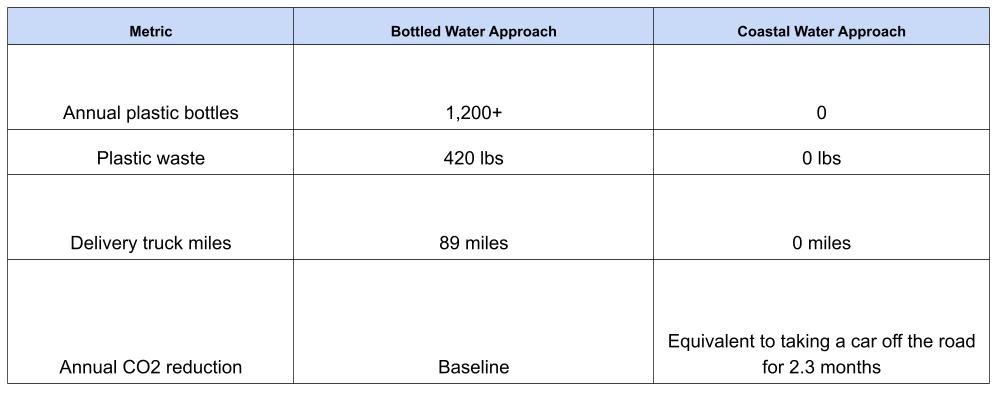
Plastic waste - The average office generates 1,200+ single-use bottles annually
What Appears
Clean, filtered water using the infrastructure you're already paying for—just made exceptional. Your water solution should reduce waste, not create it.
By the Numbers: Environmental Impact
The Future of Workplace Hydration: Combining Municipal Water + Advanced Filtration
Think of municipal tap water as the reliable foundation—the source that makes modern life possible.
Think of Coastal Water as the refinement layer—the system that transforms good into exceptional.
This isn't an either/or decision. It's a partnership model that leverages existing infrastructure while optimizing the final product for your specific team.
As water quality researcher Dr. Sarah Mitchell notes:
"The last 50 feet of pipes matter more than the first 50 miles. Municipal systems deliver safety. Point-of-use systems deliver experience."
Together, they deliver what your Central Coast workplace deserves: safe, sustainable, delicious hydration that your team will actually use.
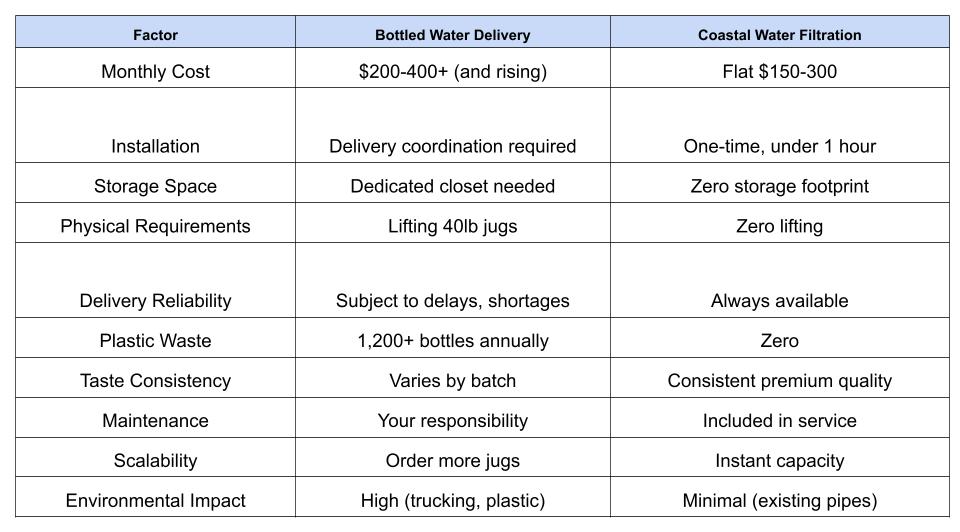
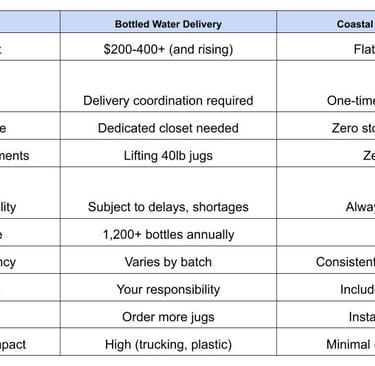
Office Water Filtration vs. Bottled Water Delivery: The Complete Comparison
Common Questions About Office Water Filtration
Q: Won't this just add another monthly expense to our budget?
A: Let's compare actual numbers. Most Central Coast offices spend $200-400 monthly on bottled water delivery, plus hidden costs: staff time coordinating deliveries, storage space that could be used productively, and the environmental cost you're increasingly being asked to report on.
Coastal Water's flat $150-300 monthly fee includes installation, all filters, scheduled maintenance, and priority repairs. For most offices, it's cost-neutral or saves money—while dramatically improving quality and sustainability.
Q: What if our team doesn't notice the difference?
A: That's exactly why we offer the 5-day free trial. We've conducted 200+ trials in the past year across the Central Coast. Here's what typically happens:
Day 1: Skepticism
Day 2: "This does taste cleaner"
Day 3: People stop bringing bottles from home
Day 5: Your office manager asks how quickly we can make it permanent
If your team genuinely doesn't notice improvement, we uninstall—no questions asked, no fees. That's happened exactly 12 times in 200+ trials.
Q: How often does the system require maintenance?
A: We handle everything on a scheduled basis—you never have to think about it. Filter replacements happen every 6 months (we schedule in advance). Full system sanitization annually. Our antimicrobial surface protection means the system stays cleaner between visits.
Average maintenance visit: 20 minutes, scheduled at your convenience, zero disruption to your team. Compare that to coordinating bottled water deliveries every 2-3 weeks.
Q: Is filtered tap water really better than bottled water?
A: Better is the wrong word—it's different in important ways. Bottled water quality varies by brand and batch, sits in plastic for months, and generates massive environmental waste.
Coastal Water filters your local municipal supply (which is already tested daily) right before consumption using advanced multi-stage filtration including reverse osmosis that removes what municipalities don't target: chlorine taste, emerging contaminants, microplastics.
The water is fresher (filtered seconds before drinking versus weeks in plastic) and consistently higher quality. Plus, you're not drinking water that's been sitting in plastic under fluorescent lights in a storage closet.
Q: What contaminants does this actually remove that matter for the Central Coast?
A: Great question—let's be specific to our region. Our Culligan systems remove or reduce:
Chlorine and chloramine: Present in all municipal water (2-4 ppm locally)
PFAS: Recently detected in low levels in 23% of Central Coast samples
Lead and copper: From older building pipes (especially relevant in pre-1980 buildings)
Microplastics: Increasingly found in all water sources
Sediment and rust: From aging infrastructure
Volatile organic compounds: Affecting taste and odor
Heavy metals: Including arsenic, chromium, and mercury
Nitrates: Common in agricultural areas
Our reverse osmosis technology reduces up to 99% of these harmful drinking water contaminants. We provide detailed before/after testing for any client who requests it.
Q: What's the catch? This sounds too easy.
A: No catch—just a different business model. We make money on long-term service relationships, not on selling you equipment. You pay monthly for water quality as a service.
We handle installation, maintenance, repairs, everything. If you're not happy, you cancel—no long-term contracts, no buyout fees. Our business depends on you being satisfied enough to renew monthly, which is why 94% of trial clients convert and 96% of annual clients renew.
Why Some Businesses Hesitate (And Why They Shouldn't)
We've heard every objection. Here are the most common—and the reality:
"Our tap water seems fine to me."
You're probably not drinking 8 glasses of it daily. Ask your team. Better yet, do a blind taste test: tap water vs. filtered. The difference is immediate and obvious. Even if you don't mind the chlorine taste, many of your employees do—that's why they're bringing bottles from home.
"This seems like an expensive upgrade for something that already works."
Let's talk ROI. You're already paying for water through utility bills. You're likely already paying $200-400/month for bottled delivery or purchases. Coastal Water typically costs the same or less than your current solution while providing better quality, zero waste, and eliminating operational headaches.
The question isn't "can we afford filtration"—it's "can we afford to keep paying for inferior water?"
"Switching sounds like too much hassle."
Installation takes 45 minutes. We schedule at your convenience. We handle everything: equipment, filters, maintenance, repairs. Your office manager's involvement: showing us where you want the dispenser and giving us 45 minutes access. That's it.
Compare that to the ongoing hassle of coordinating bottled water deliveries every 2-3 weeks for years.
"What if the system breaks or stops working?"
Every Coastal Water system includes priority repair service. If something goes wrong (rare, but it happens), we respond same-day for emergencies. Average repair time: under 2 hours.
Meanwhile, your municipal tap water still works—you're never without water access. Compare that to bottled delivery: if they miss a delivery or you run out unexpectedly, you're stuck until the next scheduled delivery.
Experience the Difference Yourself
Every Coastal Water installation includes:
✓ Professional installation by certified Culligan technicians (under 1 hour)
✓ All filters and consumables (replaced on schedule)
✓ Scheduled maintenance (every 6 months, we coordinate with you)
✓ Priority repair service (same-day response for emergencies)
✓ 5-Day Free Trial so you experience the difference risk-free
Zero-Risk Trial
5 days. No credit card required. No obligation. If your team doesn't notice the difference, we'll uninstall—no questions asked.
Ready to See What Your Team's Been Missing?
Municipal tap water gets you 90% of the way there.
We handle the final 10% that transforms your workplace hydration from functional to exceptional.
Schedule Your Free Trial - Three Easy Ways:
📞 Prefer to talk? Call (805) 698-2988
No phone tree. Monday-Friday, 8am-5pm.
📄 Just exploring? Book your Free Consultation
Frequently Asked Questions (Additional)
How long does installation take?
Under one hour from start to finish. Our certified Culligan technicians handle everything.
Do you service all of the Central Coast?
Yes. We serve Santa Barbara, San Luis Obispo, and Ventura County.
What's included in the monthly fee?
Everything: installation, all filters, scheduled maintenance, priority repairs, and customer support.
Can we scale up as our team grows?
Absolutely. We can add dispensers or upgrade your system at any time.
What if we move offices?
We'll relocate your system to your new location at no additional cost.
What technology does Culligan use?
Culligan's bottle-free coolers use multi-stage filtration including sediment filters, carbon block filtration, reverse osmosis (reducing up to 99% of contaminants), mineral enhancement, UV-C sanitization, and antimicrobial surface protection.
Is this the same as a water softener?
No. Water softeners address hard water issues (calcium and magnesium) in your entire building. Coastal Water's bottle-free coolers focus on drinking water quality at the point of use, removing contaminants and improving taste.
About Coastal Water
The Coastal Water team is a part of Coastal Copy, which has been serving Central Coast businesses since 1978. We aim to serve over 5,000 clients from Santa Barbara to Ventura County using trusted Culligan technology and equipment. Our mission: exceptional water quality without the environmental waste.
Serving Santa Barbara, San Luis Obispo, and Ventura County businesses
Coastal Water - Pure. Simple. Local.
Contact Information:
Phone: (805) 698-2988
Service Area: Santa Barbara, San Luis Obispo, Ventura County
Hours: Monday-Friday, 8am-5pm
Coastal Water
Pure. Simple. Local.
© 2026 Coastal Water | Serving Ventura • Santa Barbara • San Luis Obispo
Designed by Santa Barbara AI